%201.svg)
Strategy, Roadmap, and Execution Are Not the Same Thing - And Confusing Them Breaks Transformation
Master the Transformation Trifecta. Uncover the critical distinctions between strategy (direction), roadmap (sequence), and execution (outcomes) required to drive high-velocity delivery and scalable business value.

Many transformation programs do not stall because the organization lacks budget, talent, executive support, or urgency.
They stall because three very different things get blended together as if they were one:
strategy, roadmap, and execution.
This confusion is common, and it is costly.
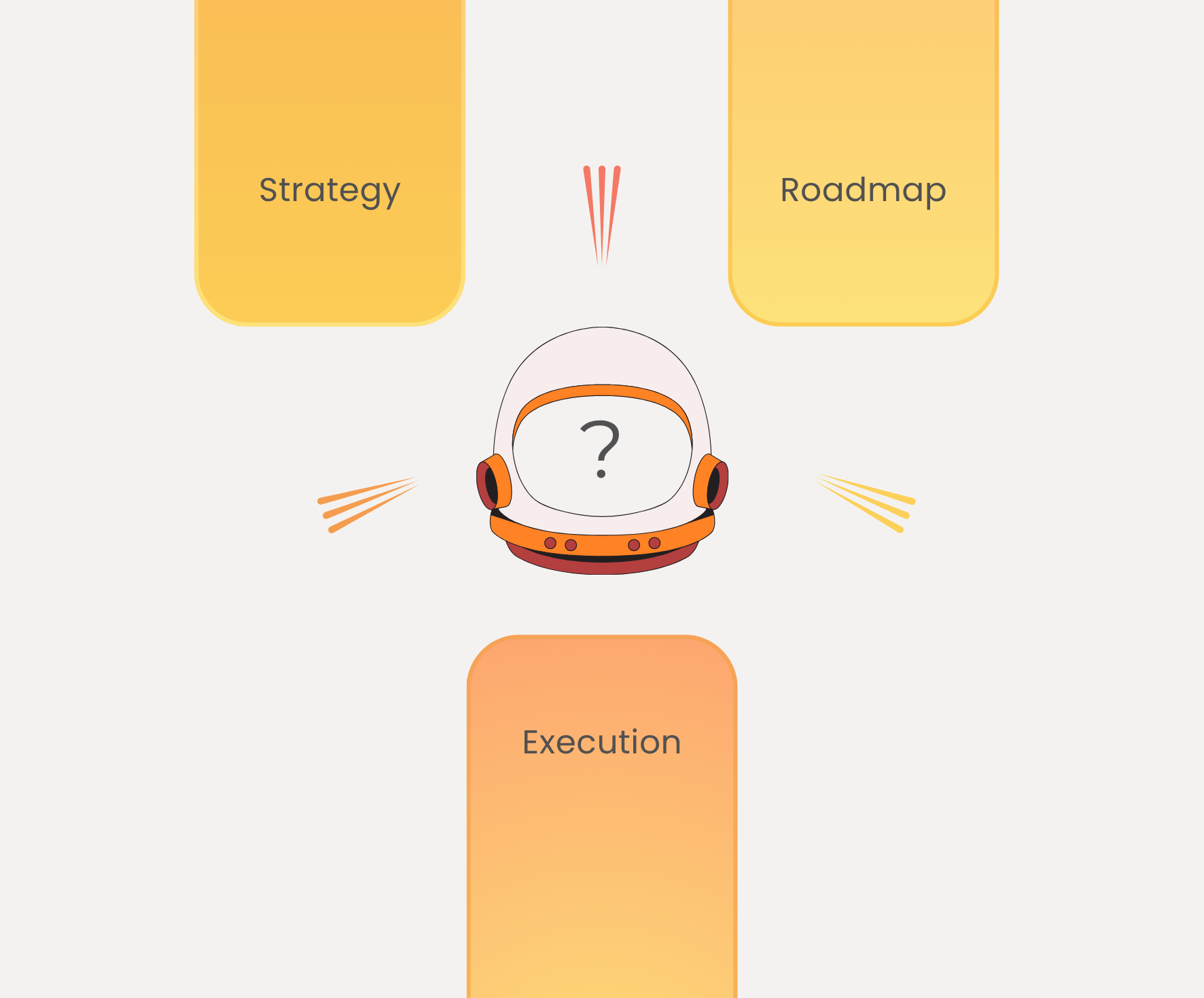
In many organizations, leaders say “strategy” when they mean a list of initiatives. Teams talk about “execution” when they are really discussing sequencing. Roadmaps are presented as proof of strategic clarity, even when the underlying choices were never fully made. Everyone stays busy, but the logic connecting direction, priorities, and delivery becomes weak or disappears entirely.
Once that happens, the transformation starts drifting. Not always dramatically. Often gradually. Meetings still happen. Projects still move. Status reports still look respectable. But beneath the activity, alignment starts to break down.
That is why this distinction matters so much.
A transformation program needs all three: clear strategy, credible roadmap, and disciplined execution. But it also needs them to stay in the right order and in the right relationship.
When they do not, the organization starts mistaking motion for progress.
The core distinction
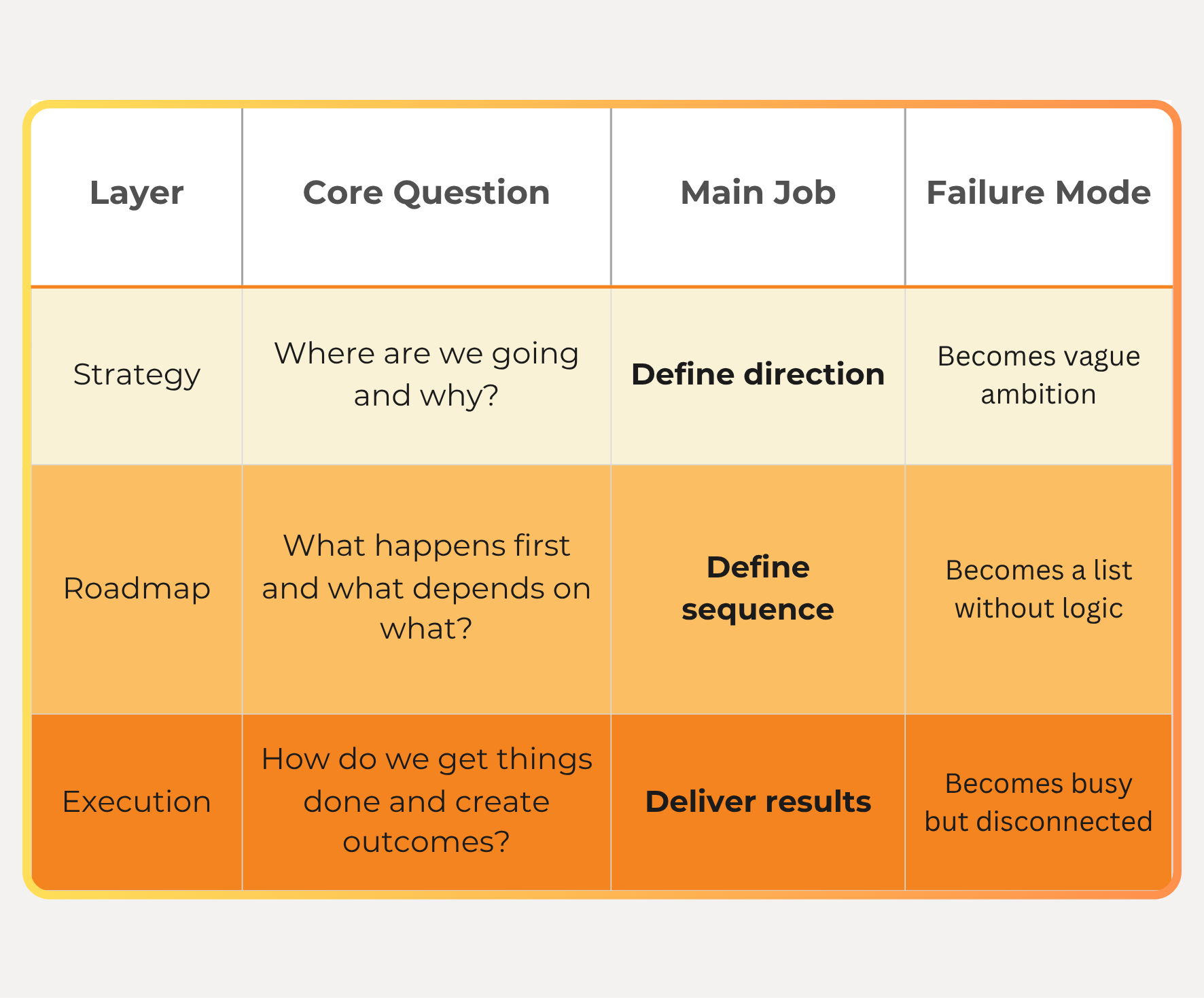
At a high level, the difference is simple.
Strategy defines direction.
It answers: Where are we going, and why?
Roadmap defines sequence.
It answers: What happens first, what follows, and what depends on what?
Execution delivers results.
It answers: How do we actually get things done, adapt, and create measurable value?
That sounds straightforward. In theory, most leaders would agree with it immediately.
In practice, many transformation efforts blur these layers together until they are almost impossible to separate.
That is where trouble begins.
What strategy actually is
A real strategy is not a vision statement, a slogan, or an aspiration deck.
It is a set of choices.
It defines the intended direction of the organization and gives people a basis for decision-making. It clarifies what matters most, what outcomes the organization is trying to create, what capabilities need to be built, and just as importantly, what will not be prioritized.
That last part matters more than many organizations admit.
Without choice, there is no real strategy. There is only ambition.
A strong transformation strategy does not try to describe everything the organization could possibly improve. It identifies the few critical shifts that matter most. It creates focus. It establishes why change is necessary and what success should look like at the business level.
It should influence decisions such as:
- which capabilities deserve investment first
- which parts of the operating model need to change
- which legacy constraints should be accepted temporarily and which must be removed
- which outcomes matter most in the near term
- which trade-offs leadership is willing to make
If those choices are not visible, then what the organization calls “strategy” is often just broad intent dressed up as structure.
And broad intent does not guide transformation very well.
What a roadmap actually is
A roadmap is not strategy.
A roadmap is the translation of strategy into sequence.
It takes the chosen direction and turns it into a practical path. It reflects timing, dependencies, constraints, resource realities, risks, and phases. It helps the organization understand what has to happen first, what can move in parallel, and what cannot reasonably be attempted yet.
A good roadmap is not just a list of workstreams. It is a logic model for movement.
That means a credible roadmap should show:
- the major phases of change
- the order in which capabilities are built
- critical dependencies
- decision points
- realistic pacing
- areas where learning or validation is needed before scaling
It should also acknowledge reality.
Transformation roadmaps fail when they are built as commitment theater instead of sequence discipline. A roadmap that tries to satisfy every stakeholder usually becomes overloaded, politically negotiated, and structurally weak. It may look comprehensive, but it stops being useful because it no longer reflects an honest view of how change can actually happen.
A roadmap should not promise everything to everyone. It should help the organization move in the right order.
That is a different job.
What execution actually is
Execution is where the organization turns intent and sequence into outcomes.
It is not just delivery activity. It is disciplined movement under real-world conditions.
Execution includes building, testing, deciding, adapting, removing blockers, managing trade-offs, learning from results, and staying aligned to the transformation’s purpose even when circumstances change.
This is where plans encounter reality.
Requirements turn out to be incomplete. Dependencies become harder than expected. Teams discover technical debt, organizational friction, skill gaps, vendor limitations, and political resistance. New information emerges. Priorities shift. Market pressure changes. Sometimes the roadmap needs to be adjusted. Sometimes parts of the strategy need refining.
That does not mean execution failed. That is execution.
Good execution is not blind adherence to a plan. It is a disciplined delivery with feedback and correction.
But execution becomes very difficult when the other layers are weak.
If strategy is vague, execution teams are forced to interpret priorities for themselves. If the roadmap is not credible, execution becomes reactive and fragmented. Teams end up working hard while absorbing confusion that should have been resolved earlier.
Then, unfairly, execution gets blamed for failures that were designed into the system from the start.
Where organizations usually go wrong
The most common failure patterns are surprisingly familiar.
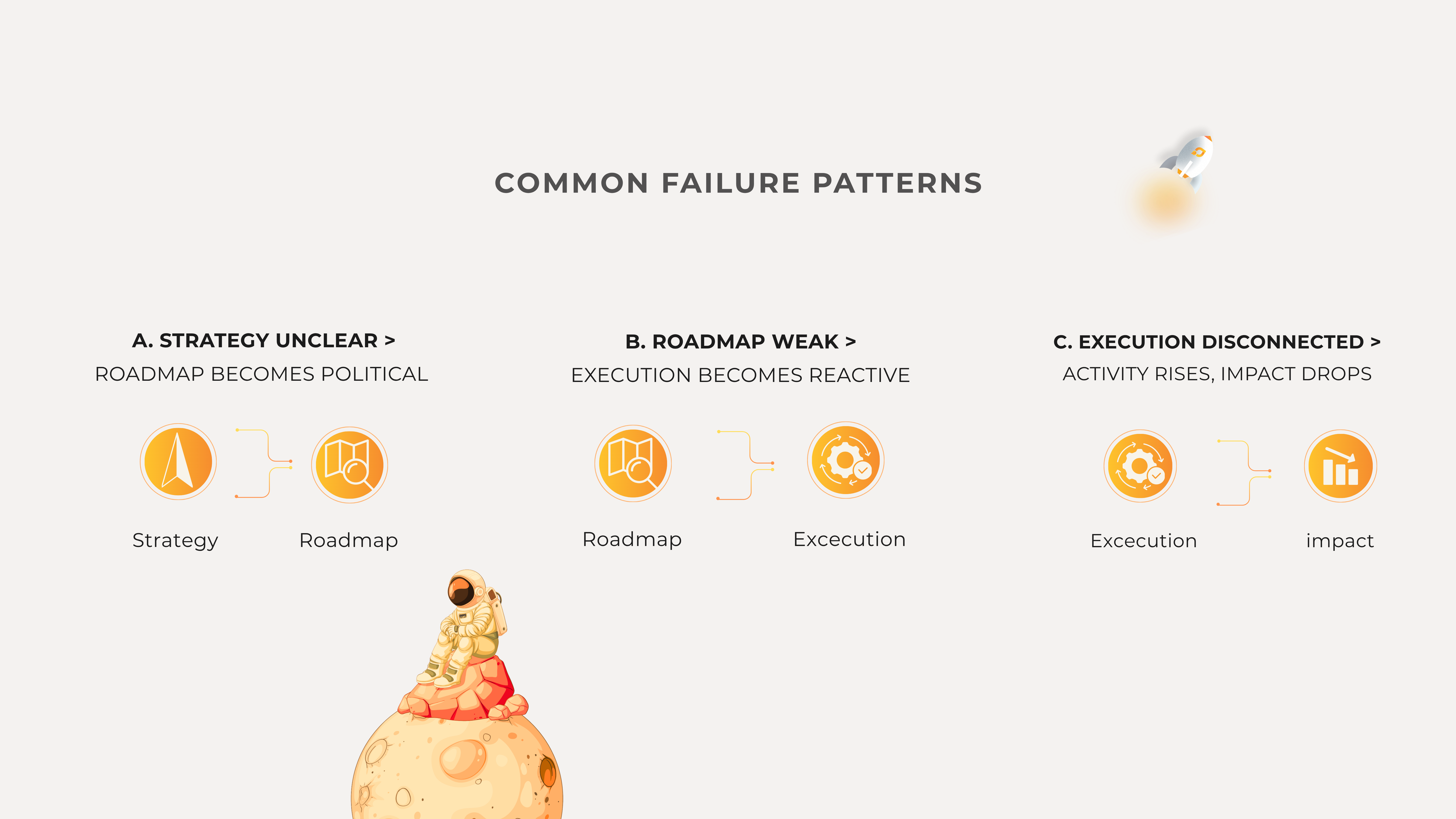
1. A roadmap exists, but the strategy is weak
This happens often. The organization produces a multi-quarter plan with milestones, workstreams, and timelines, but the underlying strategic choices are still fuzzy.
Why are we doing this now? What are the business outcomes we care about most? Which capabilities matter most? What trade-offs are we willing to make?
If those questions are not settled, the roadmap has no real spine. It may look organized, but it is not anchored. As pressure increases, the roadmap becomes vulnerable to politics, short-term reactions, and competing interpretations of success.
2. Strategy exists on slides, but not in decisions
Sometimes the opposite happens. The organization has a polished strategy narrative. The language is strong. The ambition is compelling. But when real decisions need to be made, the strategy does not meaningfully narrow options.
That is usually a sign that the “strategy” is too abstract.
If strategy does not shape funding, prioritization, governance, architecture, delivery goals, and trade-offs, then it is not doing its job. It may inspire people for a moment, but it will not align the transformation over time.
3. Execution is busy, but disconnected
This is one of the most expensive patterns.
Delivery teams are active. Sprints are running. Work is being tracked. Milestones are being reported. But the connection between execution and strategic intent is getting weaker. Local priorities begin to override program logic. Tactical urgency starts replacing deliberate sequence.
At that point, the organization may appear productive while becoming less effective.
This is the moment where transformation starts producing a lot of output with too little outcome.
4. The roadmap becomes a substitute for leadership choices
In some organizations, hard strategic decisions are delayed or avoided, and the roadmap quietly absorbs the ambiguity.
Instead of deciding what matters most, leaders try to include everything. Instead of resolving trade-offs, they sequence around them. Instead of acknowledging constraints openly, they create optimistic parallel tracks.
The roadmap becomes overloaded because it is compensating for unresolved leadership work.
That never ends well.
5. Execution teams carry the burden of upstream confusion
When strategy is unclear and the roadmap is weak, the burden falls downstream.
Program managers, architects, engineering leaders, and delivery teams are asked to “make it work.” They spend enormous effort reconciling contradictions, filling gaps, managing expectations, and preserving momentum. They can hold things together for a while, but eventually the cost shows up in delays, frustration, rework, stakeholder fatigue, and declining confidence.
This is not an execution problem in the narrow sense.
It is a structure problem.
Why this confusion is so damaging in transformation work
In a stable environment, these distinctions may feel less urgent. Routine operational delivery can continue for some time even with imperfect alignment.
Transformation is different.
Transformation usually involves structural change: new platforms, new capabilities, new governance, new skills, new roles, new data models, new processes, new decision rights, new ways of funding and measuring progress. The work is uncertain by nature. Dependencies are high. Trade-offs are constant. The cost of confusion compounds quickly.
That is why unclear separation between strategy, roadmap, and execution is especially dangerous in transformation programs.
When these layers are blurred:
- teams cannot tell whether they are challenging the direction or just the sequence
- leaders struggle to distinguish a planning problem from a delivery problem
- stakeholders escalate noise because priorities were never ranked clearly
- delivery plans become unstable because strategic choices were not fully made
- success metrics become inconsistent across different layers of the program
Eventually, everyone starts using the same words while meaning different things.
And once that happens, alignment becomes performative rather than real.
What good looks like
Healthy transformation programs keep these layers distinct but connected.
A good strategy is concise enough to guide real choices. It does not try to become a project plan.
A good roadmap is practical enough to create sequence and focus. It does not pretend to be strategy.
Good execution is disciplined enough to produce value under pressure. It does not operate as if activity alone equals progress.
More importantly, the links between them remain visible.
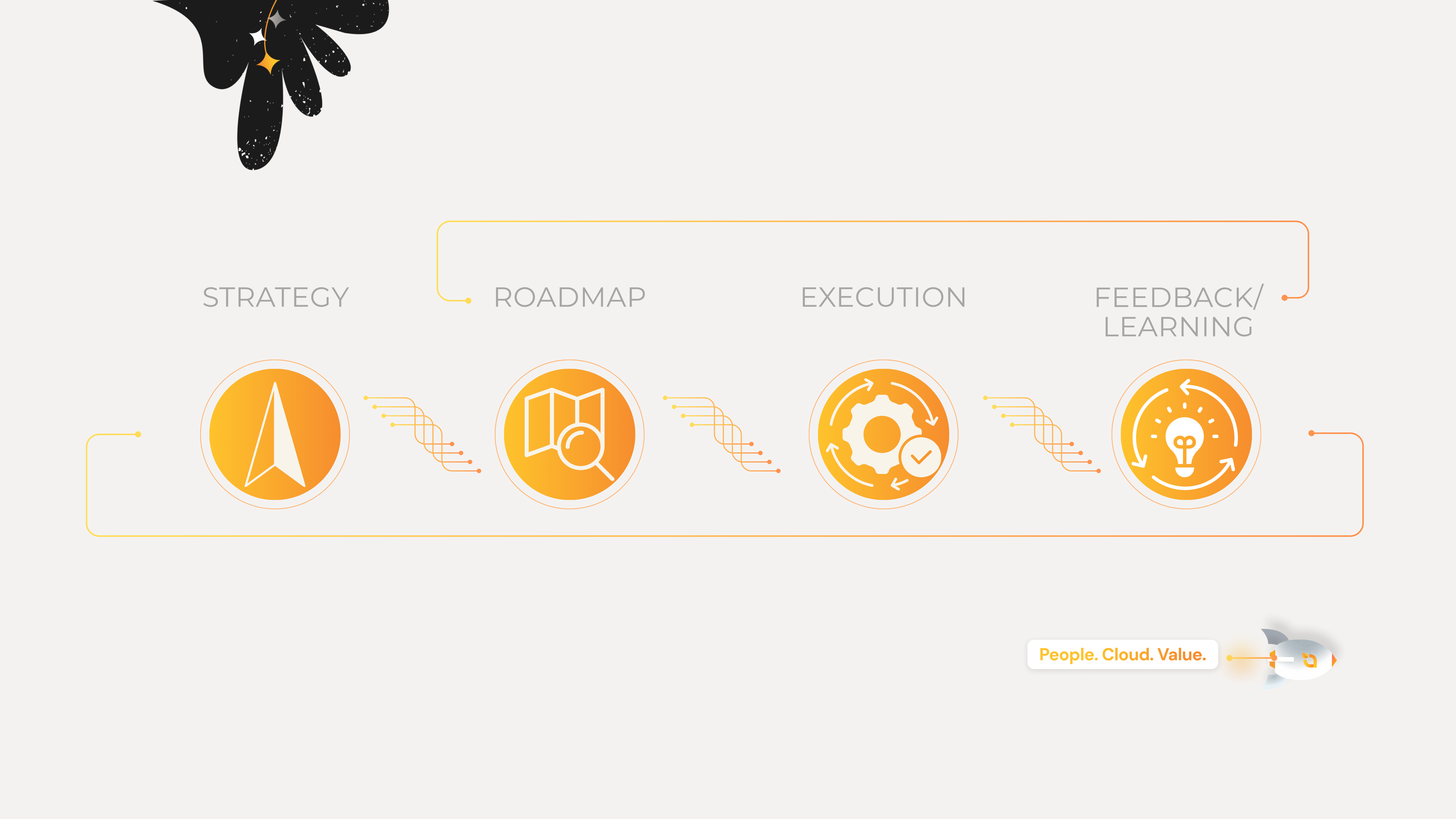
The strategy should clearly inform the roadmap. The roadmap should clearly inform execution. And execution should generate learning that may refine the roadmap and occasionally challenge assumptions in the strategy.
That relationship is dynamic, but it is not random.
You can usually recognize healthy alignment by asking a few simple questions.
Can leaders explain the strategic choices in plain language?
Can the roadmap clearly show why certain things are happening now and others later?
Can execution teams explain how their current work ties back to outcomes that matter?
Can the organization tell the difference between a strategic change, a roadmap adjustment, and a delivery issue?
If the answer is no, then the transformation is probably carrying hidden alignment risk.
A practical test for leaders
When a program starts struggling, leaders often ask whether the issue is execution.
That is a fair question, but it is usually too narrow.
Before concluding that delivery is the root problem, it is worth testing all three layers separately.
Start with strategy:
- Is the direction actually clear?
- Have the major choices been made?
- Are the trade-offs explicit?
- Does the strategy help people decide, or only describe ambition?
Then test the roadmap:
- Does the sequence make sense?
- Are dependencies understood?
- Is the pacing credible?
- Does the roadmap reflect reality, or negotiation?
Then test execution:
- Are teams able to deliver against the current sequence?
- Are blockers being addressed quickly enough?
- Is feedback being incorporated?
- Are outcomes improving, or only activity levels?
This matters because different problems need different interventions.
If the strategy is weak, better project management will not save the transformation.
If the roadmap is unrealistic, stronger delivery discipline will only produce more visible strain.
If execution is genuinely poor, rewriting the strategy will not fix it.
Confusing the layers leads to the wrong remedies.
And wrong remedies are one of the fastest ways to prolong transformation pain.
The role of leadership
This topic is not just a planning issue. It is a leadership issue.
Leaders often underestimate how much organizational confusion they create when these layers are not kept clean.
When strategy is vague, people invent their own interpretations.
When roadmaps are politically overloaded, teams stop trusting sequence.
When execution struggles under impossible conditions, confidence drops and blame spreads.
Strong leadership does not mean controlling every detail. It means creating enough clarity at the right layer so the next layer can do its job.
That means leaders must be willing to:
- make real choices
- say no to lower-priority work
- separate ambition from sequence
- avoid using roadmaps as substitutes for strategy
- avoid blaming execution for unresolved upstream ambiguity
.png)
Transformation requires discipline not only in delivery, but in thinking.
And that discipline starts at the top.
Final thought
A strategy is not a roadmap.
A roadmap is not execution.
And execution, by itself, is not transformation.
These distinctions may sound basic, but organizations ignore them all the time. When they do, transformation becomes slower, more political, more expensive, and more fragile than it needs to be.
The goal is not to build perfect separation between the three. They must inform each other. But they must not collapse into each other.
Strategy should define direction.
Roadmap should define sequence.
Execution should deliver outcomes.
When those layers are clear and connected, transformation has a real chance.
When they are blurred, the organization may still produce a lot of activity.
It just will not produce enough progress.
FAQ based on the blog
Q1: Why do so many digital transformation programs stall?
Because teams often mix up strategy, roadmap, and execution and talk about them almost interchangeably, the program generates a lot of movement but not enough real progress.
Q2: What is the difference between strategy and roadmap in transformation work?
Strategy is about direction: where you are trying to go, why it matters, and what you really want to change, while roadmap is about sequence: what happens first, what depends on what, and what is realistic now versus later.
Q3: What does execution actually mean in a transformation context?
Execution is the day‑to‑day delivery work: decisions, trade‑offs, handling blockers, delivery pressure, and course correction while trying to move the roadmap forward.
Q4: What happens when strategy is not clear enough?
When strategy is vague and reduced to broad statements, it stops guiding real choices, the roadmap starts optimizing for something else, and execution teams get measured only on short‑term delivery.
Q5: How can I tell my “roadmap” is just a long list of initiatives?
If your roadmap looks like a backlog with many unprioritized initiatives, unclear dependencies, and no realistic phasing, it is a list, not a roadmap that creates focus.
Q6: Why is it so important to keep strategy, roadmap, and execution connected?
Without that connection, strategy becomes a slogan, the roadmap becomes just a list, and execution becomes noise instead of coordinated progress toward a clear outcome.