%201.svg)
When Digital Transformation Fails, It Is Often Not a Technology Problem
Many “digital transformations” fail not because of cloud or AI, but due to fragmentation: misaligned priorities, weak operating models, and unclear ownership across the organization.

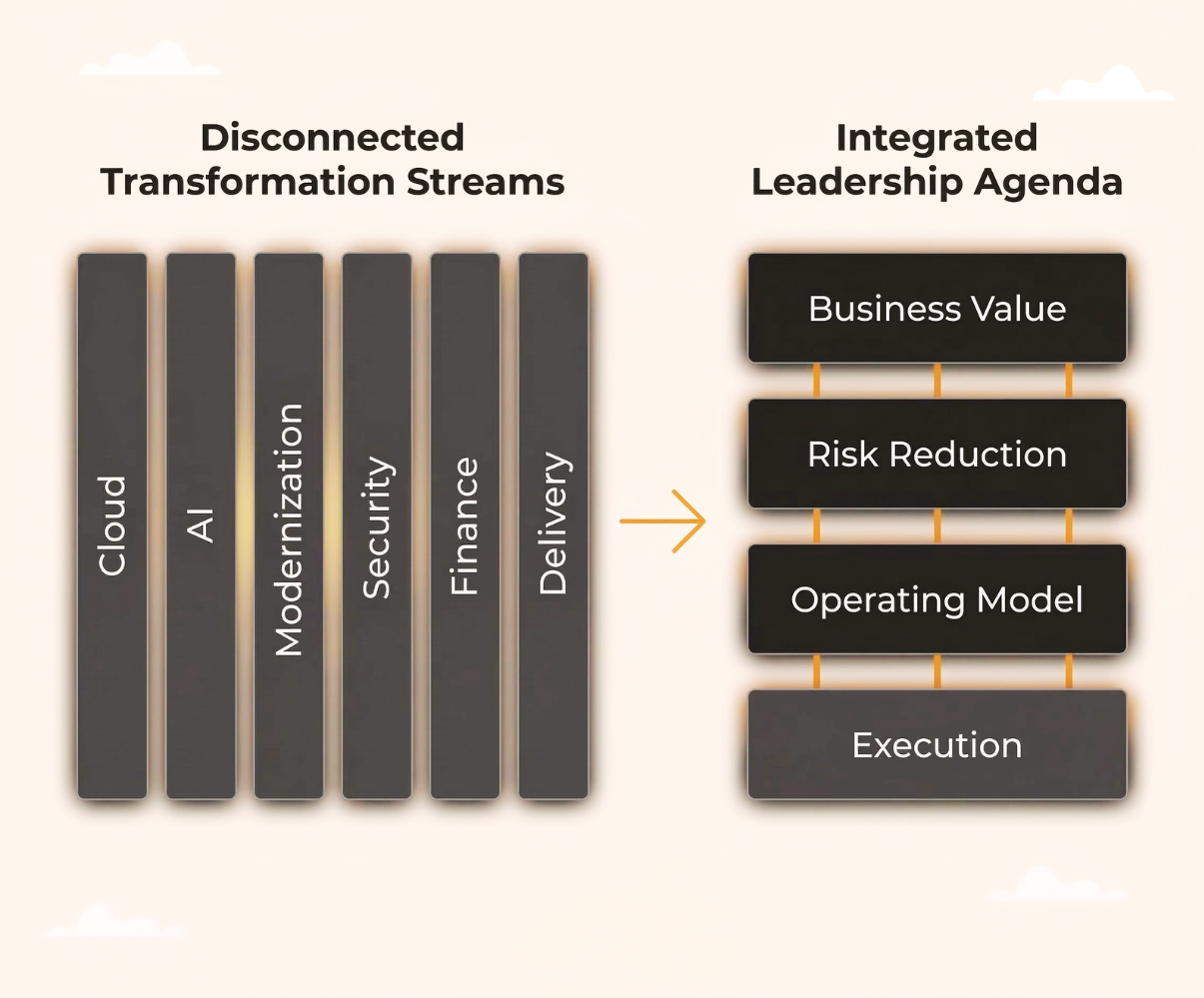
Cloud is moving. AI is moving. Modernization is moving. Security is doing its job. Finance is asking hard questions. Delivery teams are under pressure to ship.
And still, the organization is not really transforming.
I’ve seen well-funded transformation programs fail for a very ordinary reason: fragmentation.
They had smart people, real momentum, and no shortage of activity. From the outside, some of them looked healthy for a long time. There were roadmaps, steering meetings, milestones, dashboards, new tools, sometimes even visible wins.
But underneath all that movement, the effort was split.
Cloud had its own agenda.
Modernization had another.
Security was adding controls.
AI entered fast, usually with energy and executive attention.
Finance was pushing for efficiency.
Delivery teams were trying to keep things moving while absorbing all of the above.
None of that is inherently wrong. Most of it is necessary.
The trouble starts when each of those efforts runs on a different logic, with different priorities, different owners, and sometimes a completely different definition of success.
That is where transformation starts to look bigger than it really is.
Activity Is Not Transformation
One of the easiest mistakes to make in a large transformation is to confuse motion with progress.
An organization can be doing many reasonable things at the same time:
- migrating workloads
- replacing legacy components
- introducing platform capabilities
- setting up governance forums
- experimenting with AI
- building a FinOps practice
- reshaping delivery structures
And still not create meaningful business movement.
Because those things do not connect themselves.
At some point, the harder questions matter more:
- What business outcome are we actually trying to improve?
- Which risks are we reducing, and which ones are we quietly introducing?
- What complexity are we removing, not just moving around?
- Which capabilities belong in a central team, and which should stay closer to delivery?
- Can the operating model support the speed and scale the strategy assumes?
Those are not purely technology questions. They are leadership questions.
That view is not new. Back at AWS re:Invent 2020, Andy Jassy’s message on reinvention was summarized in the AWS liveblog in very direct terms: the key challenges were leadership challenges, not technical ones.
I think that framing still holds up.
Because in many organizations, the real breakdown does not happen when the platform is selected or the architecture diagram is drawn. It happens when priorities clash, incentives pull in different directions, and nobody really owns the trade-offs across the whole effort.
What Fragmentation Actually Looks Like
Fragmentation is usually not dramatic. That is why it survives for so long.
It often looks reasonable.
It looks like a cloud program measuring adoption while the business is asking for agility, resilience, and faster product change.
It looks like a modernization initiative focused on replacing old technology, while nobody is really aligning that work to process simplification or clearer operating ownership.
It looks like security and governance being brought in too late, then blamed for slowing things down.
It looks like AI pilots creating excitement while delivery teams are still dealing with weak documentation, architecture sprawl, unclear ownership, and brittle release processes.
It looks like finance asking for efficiency after major technology decisions have already introduced new cost and complexity.
And very often, it looks like delivery teams carrying the weight of all these unresolved decisions without the authority or clarity to reconcile them.
This kind of fragmentation is expensive, but it usually does not announce itself early.
It shows up as:
- slower decisions
- duplicated effort
- blurred ownership
- conflicting incentives
- governance overhead
- bad sequencing
- and eventually, fatigue
The organization stays busy. Sometimes it even looks mature from a distance.
But the parts are not strengthening each other.
AI Changes a Lot. It Does Not Change Human Behavior By Itself.
This part matters more now than it did even a year or two ago.
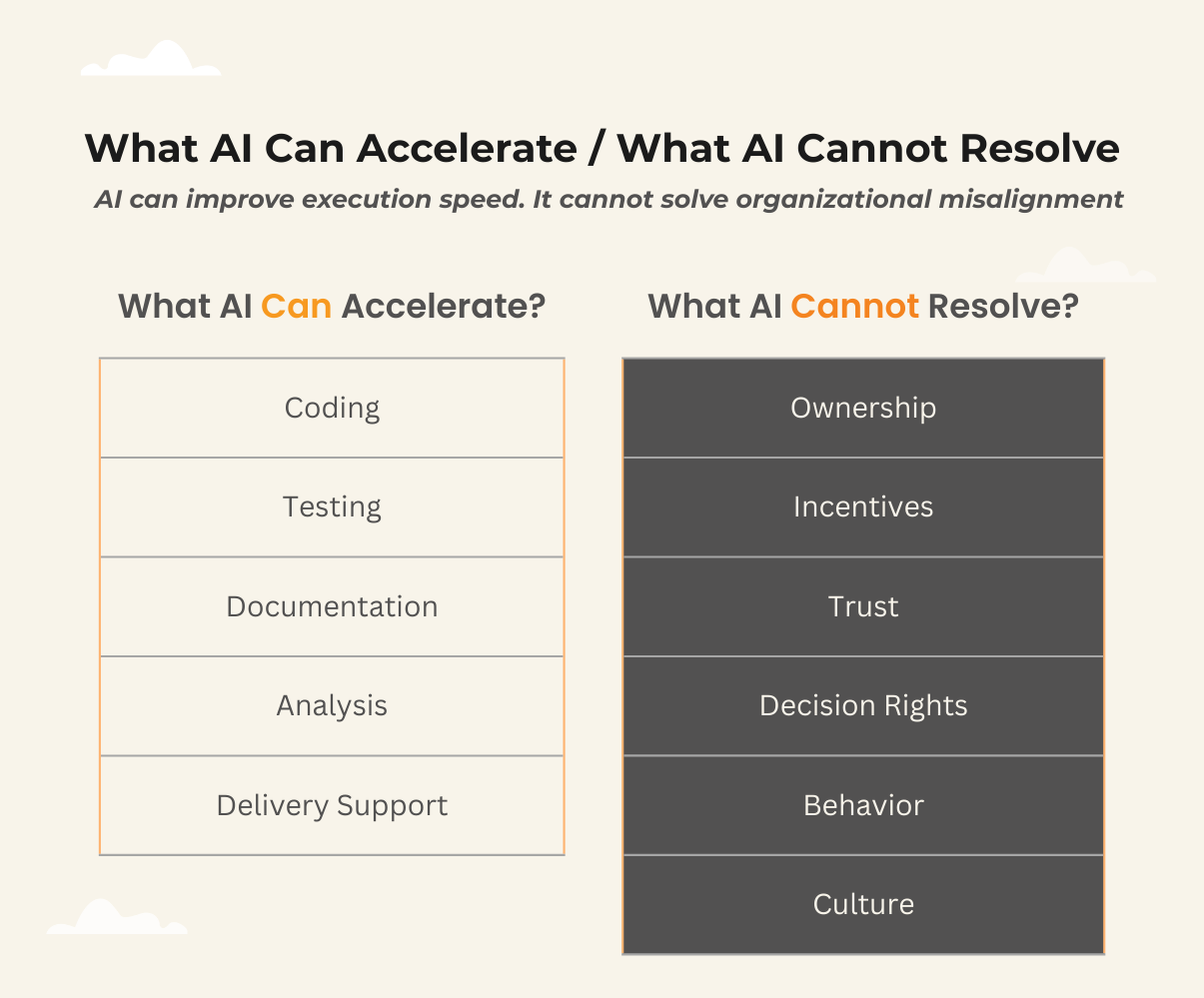
AI can already help teams produce a surprising amount of technology work. It can accelerate coding, documentation, testing, analysis, troubleshooting, and in some cases even parts of design and delivery planning. Jassy has called generative AI a technology revolution with the potential to reshape customer experiences, and Amazon has been explicit about how central AI has become to its future direction.
So yes, AI can help build quite good technology.
But it cannot overrule people.
It does not fix confused ownership.
It does not resolve incentive misalignment.
It does not remove organizational politics.
It does not create accountability where none exists.
And it definitely does not change behavior just because the tooling got better.
If a company is fragmented, AI may even amplify the problem.
It can make each team faster in its own lane while the organization as a whole remains misaligned.
More code. More pilots. More artifacts. More output.
Not necessarily more transformation.
That is why I do not think the main question is whether AI will improve delivery. It clearly will.
The harder question is whether leadership, structure, and culture will evolve fast enough to make those gains matter across the organization.
Jassy has also been blunt about culture and bureaucracy at Amazon, arguing that culture needs active reinforcement and that excessive layers and bureaucracy slow execution. That is relevant here too: even strong technology capability underperforms when the surrounding organization becomes slow, layered, or unclear.
Why Technology Gets Blamed For The Wrong Problem
When a transformation effort disappoints, technology usually gets blamed first.
The cloud program took too long.
The target architecture became messy.
The tooling was not adopted.
The modernization was too expensive.
The AI initiative did not scale.
Sometimes that criticism is fair.
But a lot of the time, those are downstream symptoms.
What actually failed was coherence.
Technology does not compensate for a fragmented transformation model.
If business priorities keep shifting, ownership is blurred, governance is reactive, and the operating model cannot support cross-functional change, even good technology choices will underperform.
So the problem is often not that the cloud platform was wrong, or the modernization approach was flawed, or the AI capability was weak.
The problem is that they were never part of one connected agenda.
Transformation Has To Be Led As One Agenda
My view is simple: transformation has to be led as one agenda.
Not as a set of parallel programs competing for attention, funding, and internal legitimacy.
That does not mean everything has to be centralized. It does not mean every team should have identical goals. And it definitely does not mean a steering committee solves the problem by itself.
It means the effort needs one shared logic.
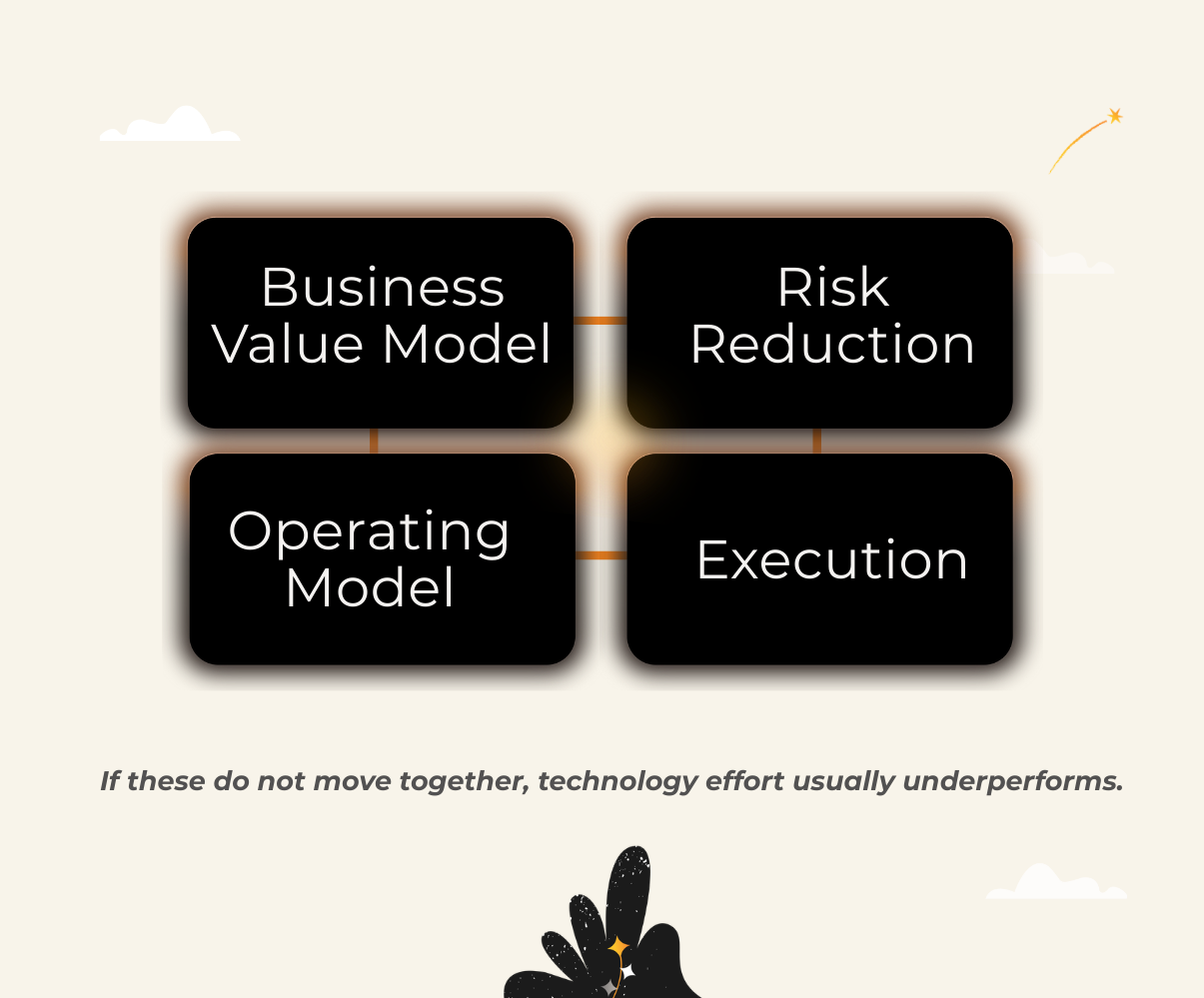
At a minimum, leaders should be able to connect four things clearly:
- business value - what should improve, for whom, and how that improvement will be recognized
- risk reduction - which business, operational, security, delivery, or technology risks are being reduced
- operating model - how ownership, decisions, governance, and enablement actually work
- execution - how work gets sequenced, delivered, measured, and adjusted in reality
These four things are tightly linked.
A modernization plan without operating model alignment usually gets stuck in prioritization and ownership debates.
A cloud program without a real value story turns into a migration exercise.
An AI program without execution discipline often becomes innovation theatre.
Governance without delivery awareness becomes bureaucracy.
Execution without risk framing becomes speed without control.
This is why I increasingly see transformation less as a pure technology challenge and more as an organizational challenge with technology inside it.
A Practical Test
A simple way to see whether a transformation is integrated or fragmented is to ask a few blunt questions.
Can business, technology, security, finance, and delivery leaders describe the same transformation in roughly the same language?
Do they agree on the main outcomes?
Is there a visible view of which risks are being reduced, and which ones are being accepted?
Can teams explain who owns trade-offs and where decisions are really made?
Do cloud, modernization, governance, and AI efforts reinforce each other, or mostly create more dependencies for delivery teams?
Would the people doing the work say the current model is helping them move, or mostly adding layers around them?
These are not sophisticated questions. But they are revealing.
When the answers are vague, inconsistent, or political, fragmentation is usually already there.
What Better Looks Like
Better does not mean perfect alignment. That is unrealistic.
It means enough coherence that the effort can hold together under pressure.
In practice, better usually looks like this:
The transformation has a small set of explicit business outcomes, not a long list of loosely connected ambitions.
The risk story is visible early, not added later when concerns show up.
Cloud, modernization, AI, governance, and delivery are treated as connected decisions, not separate narratives.
The operating model is discussed early too: ownership, central versus federated responsibilities, enablement, and decision rights.
There is some sequencing. Not everything important starts at once.
And delivery teams are not treated as the final absorbing layer for unresolved cross-functional tension.
That does not eliminate trade-offs.
It just makes them visible sooner, which is already a major improvement.
Final Thought
A lot of transformation work is done by capable people trying to solve real problems. The issue is usually not lack of effort.
It is a lack of coherence.
That is why some organizations keep investing, keep moving, keep launching new initiatives - and still feel slower than they should be, more complex than they expected, and further from business impact than the original plan suggested.
The problem is not always the technology.
Sometimes the problem is that the organization is asking technology programs to compensate for missing alignment in leadership, operating model, governance, and behavior.
That rarely ends well.
Transformation becomes much more credible when it is treated as one agenda:
business value, risk reduction, operating model, and execution.
Everything else has a better chance of landing once those four start moving together.